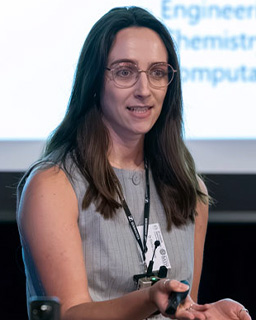


Supervisor Spotlight: Dr Simon Tang
Sustainable drug discovery inspired by nature’s own chemistry Dr Simon Tang started as a Research Fellow in the Department of Life Sciences at the University of Bath in 2025. As
Learn More
iCAST
Established in 2008, the CDT (Centre for Doctoral Training) in Sustainable Chemical Technologies: A Systems Approach (CSCT) brings together academic expertise from the University of Bath with international, industrial, academic and stakeholder partners to carry out research, training and outreach in sustainable and chemical technologies.
We equip researchers with the expertise, knowledge, and industry connections to drive real-world change. Through cutting-edge research, hands-on technical training, and impactful outreach, we prepare the next generation of innovators tackling global sustainability challenges.
Pioneering innovative solutions for a sustainable future through cutting-edge chemical research.
Equipping the next generation of scientists and engineers with skills for a sustainable world.
Engaging communities and stakeholders to promote awareness of sustainable chemical practices.
Discover how our interdisciplinary training, world-class research, and strong industry connections prepare our graduates for impactful careers in sustainability.
Sustainable drug discovery inspired by nature’s own chemistry Dr Simon Tang started as a Research Fellow in the Department of Life Sciences at the University of Bath in 2025. As
Starting a PhD is a major milestone, but for me it has also been an exciting shift into new scientific territory. After two years working in industry, I realised I wanted greater f
Laboratories are hubs of discovery, but they’re also some of the most resource-intensive spaces in any university. From high-energy equipment to single-use plastics, lab-based re
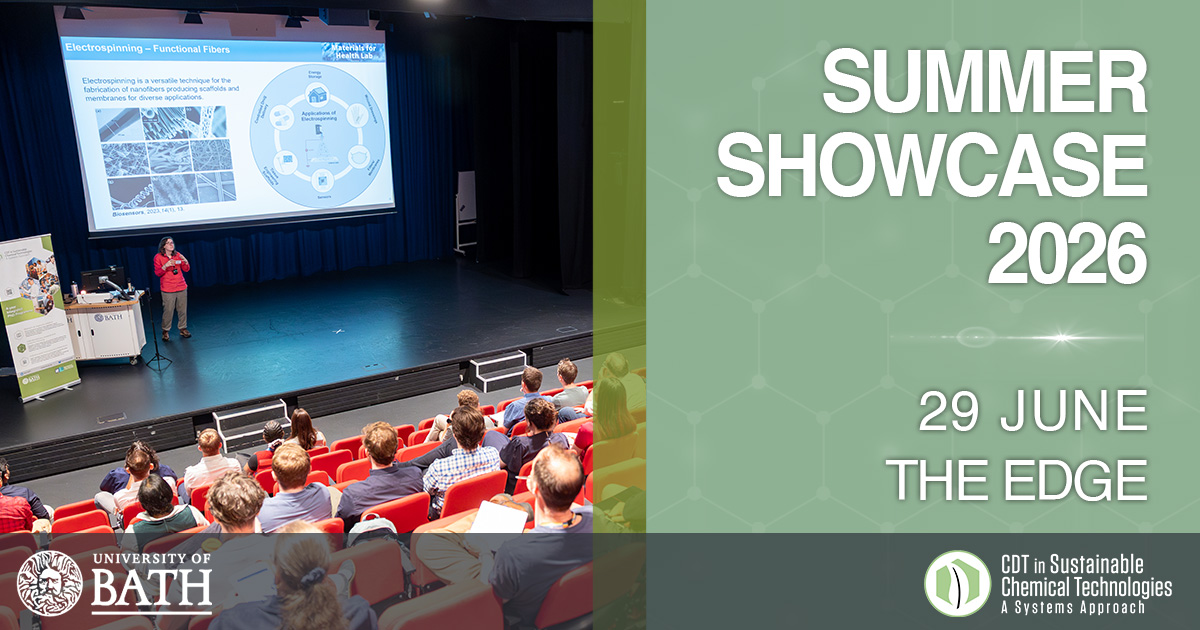
The 2025 Summer Showcase brought together a dynamic mix of researchers, industry innovators and policy experts to explore the future of sustainability. Co-hosted by the newly launc
Two CDT researchers recently participated in the Young Researchers’ Meeting (YRM) 2025, held from 10–12 June at the University of Sheffield. Organised annually by the Macro
Some of our students were flexing their Public Engagement muscles at this year’s Festival of Nature in Bath. In proud collaboration with the Centre of Excellence in Water-Based E
The Janet Scott Prize for Collaborative Research in Sustainability will once again be awarded at this year’s Summer Showcase, hosted by the Institute of Sustainability and Climat
A team of interdisciplinary PhD students – two from the ISCC and two from the Department of Chemical Engineering – recently impressed at the Bright SCIdea Challenge, ho
San Diego served up more than sunshine and street food this March – it became the global stage for world-leading chemical research at ACS Spring 2025, one of the world’s pr
We train scientists and engineers to embrace a whole systems approach in the development and implementation of sustainable chemical technologies to solve important challenges such as replacement of fossil resources with sustainable alternatives, utilisation of CO₂, plastics pollution, valorisation of waste, reuse and recycle of molecules, materials and products, and elimination of waste from processes.
The CDT in Sustainable Chemical Technologies : A Systems Approach (CSCT) is an interdisciplinary research centre, including expertise from the Departments of Architecture and Civil Engineering, Chemistry, Chemical Engineering, Electronic & Electrical Engineering, Life Sciences, Mathematics, Mechanical Engineering, Physics, and the School of Management.
PhD research in Sustainable Chemical Technologies aims to explore innovative solutions to complex environmental challenges. Students engage in cutting-edge projects, developing sustainable methods, molecules and materials to address issues such as waste reduction, renewable energy, and resource efficiency. The programme fosters creativity and collaboration, allowing students to make impactful contributions to both academic knowledge and practical applications in industry.
Students receive specialist training in key areas such as green chemistry, circular economy, artificial intelligence & machine learning and catalysis and sustainability, ensuring they are equipped with cutting-edge scientific methodologies. Training modules, developed in collaboration with industry and policy partners, include practical workshops, case studies, and technical courses that enable students to integrate sustainability into real-world applications.
Beyond technical expertise, we prepare students for leadership in industry, policy, and academia. Training in public and policy engagement, responsible research and innovation, and entrepreneurship equips graduates with communication, critical thinking, and business development skills. These workshops ensure that our researchers can translate their findings into impactful, real-world solutions.
academics
students trained
publications
Graduates
Our graduates pursue diverse career paths, leveraging the skills and expertise developed during their PhDs. A significant 57% transition into industry roles, contributing to innovation and applied research. Another 29% remain in academia, advancing knowledge through teaching and research. About 9% of our alumni excel in research management, driving strategic initiatives, while 5% embrace teaching roles, inspiring the next generation. These outcomes highlight the versatility of our graduates, equipped to address complex challenges across sectors.
Working with industry to address real-world needs in relation to sustainability has been our driving force
This brochure provides an overview of the CDT using case studies of our research projects and students.
Generic placeholder: context, needs, constraints, feedback loops, and practical direction.
Research project 2
The second research project will normally be executed in a different discipline and on a different topic compared to Research Project 1 to foster a better appreciation of the interdisciplinary aspects of research in sustainable chemical technologies. Research project 2 could be close to the topic of your PhD or at least in the same research group. You will select the topic for Research Project 2 at the start of Semester 2. It is compulsory to have a different supervisor for Project 2 to that of Project 1. You will present your findings in the form of a report and a poster.
25 Credits
Research project 1
Under the guidance of an academic supervisor, you will undertake a research project focused on sustainable chemical technologies and system thinking. During the first stage, you will undertake the necessary background reading, carry out appropriate safety assessments and devise a programme of work. At the end of the first stage, you will submit a short, formative report to your project supervisor. During the second stage of the project, you will carry out the research according to your work programme in consultation with your supervisor.
25 Credits
Public and policy engagement
Introduction to basic concepts of public and policy engagement (PPE) with science, technology, engineering and maths and the contexts in which it takes place. You will cover a wide range of approaches to PPE and audiences for PPE. As part of this unit, you will have opportunities for engaging in practical PPE work to help you build your skills and confidence when embarking upon PPE activities.
For more information see our Public Engagement page
5 Credits
Commercialisation of new technology
Learn how to develop an idea into a business concept and a marketable product. You will learn techniques and tools necessary to analyse the different pathways for new technologies to be effectively commercialised.
5 Credits
Water cycle and human health
Study the impact of human populations on the global environment, focusing specially on water resources. You will explore water as a limited resource, methodologies for water resource management and the importance of water research for human population health.
5 Credits
Systems Thinking 4: Green chemistry and process metrics
Develop a detailed understanding of scientific methodologies for the qualitative and quantitative assessment of chemical processes in terms of environmental, economic, and social impacts. Through case studies you will develop practical skills in defining appropriate system boundaries and selecting, applying and evaluating key sustainability metrics.
5 Credits
Materials for sustainable energy
Explore how the skills of chemists and engineers contribute to the development of materials and processes for sustainable energy solutions. You will study materials storage and conversion technologies such as batteries, fuel cells or hydrogen storage and explore challenges in their synthesis, fabrication, and application.
5 Credits
Catalysis and sustainability
Develop your knowledge and understanding of how catalysis can provide lower cost, less energy-consuming and more environmentally friendly processes both an industrial and laboratory scale using industrial and academic examples.
5 Credits
AI and machine learning for sustainable chemical technology
Working individually and in teams, you will use software tools to learn core AI and ML methods and apply workflows to prepare, process, and analyse data. You will explore how to harness AI and machine learning to tackle sustainability issues in key areas such as energy, environmental pollution, circular economy, and decarbonisation
5 Credits
Fundamentals of biotechnology for non-biologists
Introduce the fundamentals of molecular cell biology and bioprocess engineering.
5 Credits
Fundamentals of chemistry for non-chemists
You will develop core knowledge of organic, inorganic, physical and analytical chemistry.
5 Credits
Fundamentals of chemical engineering for non-chemical engineers
Explore the principles and practices of chemical engineering and chemical engineering processes. Using case studies from chemical and biochemical engineering, you will learn about material and energy balances as well as the principles of reaction engineering and their application to chemical and biological reactor design preparing you to work effectively in multidisciplinary teams.
5 Credits
Principles and practice of industrial ecology
Industrial Ecology is the quantification of material and energy flows through industrial systems, from ‘cradle to grave’. This allows us to evaluate and minimise the environmental footprint of our technologies and activities. In this unit, you will explore the principles and practice of industrial ecology for the development of sustainable molecules, materials, and processes.
5 Credits
Circular economy and resource efficiency
Explore the principles and practices of the circular economy and its application to sustainable chemical technologies and resource management. Taking a whole systems approach, you will get an insight how to design resource efficient chemical processes that minimise raw material consumption and waste or use waste as a resource.
5 Credits
Sustainable Development
Explore the social, economic, cultural, ethical, and political context of sustainable chemical technologies and assess their sustainability. You will gain an understanding how to consider and respond appropriately to sustainable development needs in your decision-making. Working in multi-disciplinary groups you will conduct a case study to explore motivations and priorities of different stakeholders.
5 Credits